RCF12-50JFNL
1/2" RCF RADIAFLEX Cable, Halogen Free, Flame/Fire Retardant, Low Smoke, Aluminum Outer Conductor
Rev : P1 | Rev date : 11 May 2026
- RADIAFLEX® functions as a distributed antenna to provide communications in tunnels, mines and large building complexes and is the solution for any application in confined areas.
- Slots in the aluminum outer conductor allow a controlled portion of the internal RF energy to be radiated into the surrounding environment. Conversely, a signal transmitted near the cable will couple into the slots and be carried along the cable length.
- RADIAFLEX® is used for both one-way and two-way communication systems and because of its broadband capability, a single radiating cable can handle multiple communication systems simultaneously.
- This RADIAFLEX® radiating cable utilize a low-loss cellular polyethylene foam dielectric and a corrugated copper or aluminum outer conductor which offers a combination of remarkable flexibility, high strength and excellent electrical performance.
FEATURES / BENEFITS
- Broadband radiating cable supporting all wireless application between 75 MHz to 6000 MHz
- Ideally suited for application that require low bending radius
- Robust radiating cable operational under all enviromental conditions as e.g. harsh tunnels or mines
- Ideal for In-train, Vehicle-to-Everything communication and In aircraft to wireless/satellite networks
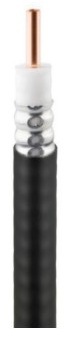
RCF cable
General Specifications |
|---|
| Size | | 1/2 |
|
Electrical Specifications |
|---|
| Max. Operating Frequency | MHz | 6000 | | Cable Type | | RCF | | Impedance | Ohm | 50 +/- 2 | | Velocity, percent | % | 86 | | Capacitance | pF/m (pF/ft) | 76 (23.2) | | DC-resistance inner conductor, ohm/km (ohm/1000ft) | Ω/km (Ω/1000ft) | 1.57 (0.48) | | DC-resistance outer conductor, ohm/km (ohm/1000ft) | Ω/km (Ω/1000ft) | 3.2 (0.98) | | Stop bands | MHz | None | | Frequency Selection | MHz | 600, 900, 1800/1900, 2200, 2400, 2500, 2700, 6000 |
|
Mechanical Specifications |
|---|
| Jacket | | Flame Retardant | | Jacket Color | | Standard Black, other colors on request | | Jacket Description | | Halogen free, non corrosive, flame retardant, low smoke | | Slot Design | | Milled (Two-Row) | | Inner Conductor Material | | Copper Clad Aluminum Wire | | Outer Conductor Material | | Annularly Corrugated Aluminum | | Diameter Inner Conductor | mm (in) | 4.8 (0.19) | | Diameter Outer Conductor | mm (in) | 13.8 (0.54) | | Diameter over Jacket Nominal | mm (in) | 16 (0.63) | | Minimum Bending Radius, Single Bend | mm (in) | 125 (5) | | Cable Weight | kg/m (lb/ft) | 0.21 (0.14) | | Tensile Force | N (lb) | 1100 (247) | | Recommended / Maximum Clamp Spacing | m (ft) | 0.6 (2) | | Minimum Distance to Wall | mm (in) | 50 (2) |
|
Testing and Environmental |
|---|
| Jacket Testing Methods | | Test methods for fire behaviour of cable :
IEC 60754-1/-2 smoke emission, halogen free, non corrosive
IEC 61034 low smoke
IEC 60332-1 flame retardant |
|
Temperature Specifications |
|---|
| Storage Temperature | °C(°F) | -10 to 50 (14 to 122 ) | | Installation Temperature | °C(°F) | -25 to 60 (-13 to 140 ) | | Operation Temperature | °C(°F) | -40 to 85 (-40 to 185 ) |
|
Attenuation |
|---|
| Frequency, MHz | Longitudinal Loss, dB/100 m (dB/100 ft) | Coupling Loss 50%, dB | Coupling Loss 95%, dB |
| 75 |
2.32 (0.71) |
62.2 |
72.9 |
| 150 |
3.31 (1.01) |
67.9 |
77.5 |
| 450 |
5.87 (1.79) |
73.2 |
84.4 |
| 800 |
7.93 (2.42) |
80.7 |
91.8 |
| 870 |
8.31 (2.53) |
77.6 |
88.9 |
| 900 |
8.46 (2.58) |
77 |
89.2 |
| 960 |
8.75 (2.67) |
71.7 |
84.4 |
| 1800 |
12.38 (3.77) |
81.5 |
92.5 |
| 1900 |
12.75 (3.89) |
79.7 |
91.5 |
| 2000 |
13.12 (4) |
77.5 |
89.4 |
| 2200 |
13.86 (4.22) |
75.8 |
88.3 |
| 2400 |
14.71 (4.48) |
70.3 |
85.1 |
| 2600 |
15.2 (4.63) |
77.8 |
90 |
| 5000 |
22.93 (6.99) |
70.2 |
81.8 |
| 5200 |
23.54 (7.17) |
71.3 |
84.9 |
| 5800 |
25.72 (7.84) |
72.8 |
86.3 |
| 6000 |
26.29 (8.01) |
75.5 |
87.8 |
|
Notes
- Coupling loss as well as longitudinal attenuation of RADIAFLEX® cables are measured by the free space method according to IEC 61196-4.
- Coupling loss values are average values of all three spatial orientations (radial, parallel and orthogonal) of dipole antenna.
- Coupling loss values are given with a tolerance of +10 dB and longitudinal loss values with a tolerance of +5%. Note: Measured values below nominal are better. They are not limited by any tolerance-range.
- As with any radiating cable, the performance in building or tunnel environments may deviate from figures based on free space method.